
Hello, friends!
You’re on Brzhechko & Nobody — where everything is about pharmaceutical advertising.
And today… we’re wrapping up the first part of our journey.
This is the last — but absolutely not the least topic in the foundations section of how advertising really works.
Before we move to cameras, actors, and light setups — we’re taking one final look at the deep psychological structure behind every ad that actually sells.
Consider this your checkpoint, your mental blueprint, before we enter the battlefield of production.
What we’ve built here isn’t a pile of theories. It’s a weapon.
So if you’ve followed the journey — get ready to use it.
And if you’re just joining now — this is the perfect place to catch up.
In the previous video, we explored one of the most disturbing yet insightful psychological experiments in history — Milgram’s Obedience Study — and its unexpected influence on advertising. If you haven’t seen it yet, make sure to watch that video first. It sets the perfect stage for today’s topic.
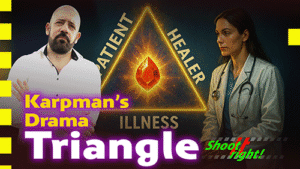
Today we’re diving into a powerful psychological model that reshapes how we approach pharmaceutical ad storytelling: Karpman’s Drama Triangle.
In advertising, especially pharma, this triangle transforms into three essential roles:
The Patient — The Healer — The Medicine.
Let’s unpack why this model matters and how it helps us craft ads that don’t just impress — but truly sell.
What is Karpman’s Drama Triangle?
Originally developed in 1968 by psychologist Stephen Karpman, this model illustrates unhealthy relational dynamics:
• The Victim,
• The Rescuer,
• and the Persecutor.
But in pharmaceutical advertising, we reinterpret this into a therapeutic narrative:
• The Patient becomes the Victim — the one suffering from illness.
• The Healer becomes the Rescuer — either a caring relative or a symbolic part of the patient’s own psyche.
• The Illness is the Persecutor — the threatening force that must be overcome.
• And the Medicine? It’s the transformational catalyst that ends the cycle.
Our goal as advertisers is not to trap the viewer inside this triangle — but to resolve it.
The Karpman Triangle: A Model of Human Behavior
Before we wrap up, let’s zoom out.
Karpman’s Drama Triangle isn’t just a narrative model for advertising.
It’s a mirror of real human relationships, repeated daily in families, offices, and societies.
In life, we often unconsciously play one of three roles:
• The Victim: “Why me?”
• The Rescuer: “Let me fix this for you.”
• The Persecutor: “It’s your fault.”
This dynamic is seductive — because it gives everyone a role and a false sense of control.
But it’s also toxic — because it locks people into cycles of blame, helplessness, and guilt.
In personal relationships:
• The Victim becomes emotionally dependent.
• The Rescuer burns out or becomes controlling.
• The Persecutor creates fear or shame.
Sound familiar?
If you’ve ever had a partner, boss, parent, or friend pull you into these roles — you know how draining it is.
And if you’ve ever been the Rescuer or Victim — you know how hard it is to stop.
This is why the model is so powerful: it describes a psychological trap that exists far beyond ads — and that’s why it works inside ads, too.
The Drama Triangle Is Dynamic
Karpman’s model isn’t static — the roles shift.
A patient might begin as the Victim, but without a path to change, they become helpless and passive. The Healer might turn manipulative or overbearing. And the Illness? It’s always lurking as an omnipresent threat.
But the Medicine, in this structure, isn’t just a product.
It’s the Philosopher’s Stone. The Holy Grail. The sacred object that dissolves the toxic dynamic and initiates healing.
It doesn’t just treat symptoms — it breaks the psychological trap.
How to Break the Triangle
The antidote to the Drama Triangle is called the Winner’s Triangle, proposed by Acey Choy.
In this healthier model:
• The Victim becomes Vulnerable but Responsible (“Yes, I’m in pain — and I can choose to change.”)
• The Rescuer becomes Caring but Boundaried (“I support you — but I won’t do it for you.”).
And don’t forget about the rank, confidence and authority of “your” Healer.
• The Persecutor becomes Assertive and Challenging (“This is hard — but you can face it.”)
In real life, breaking the triangle looks like:
• Saying no with love instead of rescuing.
• Encouraging others to own their choices.
• Taking accountability instead of seeking blame.
• Turning pain into growth, not into manipulation.
In pharmaceutical advertising, we apply the same logic, but through archetypes and framing.
To break the triangle in your ad:
✔ The Patient should not be infantilized or pitied — show them stepping into action, not lying helpless in bed. Even a small gesture of agency (reaching for the medicine, listening to advice) creates transformation.
✔ The Healer should not dominate the story — their role is to guide, not rescue. Archetypes like the Mother, Magician, or Wise King are powerful here.
✔ The Medicine must not be just a utility. Frame it as a sacred symbol of change — the Philosopher’s Stone, the missing piece that empowers healing.
Break the triangle… and you create a hero’s journey — not a rescue mission.
[Why It Matters for Pharma]
Let’s be blunt: People don’t buy medicine because they want to. They buy it to escape suffering.
That’s why pharma ads can’t just entertain or impress with cinematography.
They must:
• Identify the emotional wound (Victim)
• Present a credible guide (Healer)
• Offer a transformational solution (Medicine)
If any element is weak or unclear — the triangle collapses, projection fails, transference doesn’t happen, and your ad loses its power.
Applying the Triangle in Ads
In every effective pharma ad, these roles must be crystal clear:
• The Patient must be portrayed in shadow — tired, defeated, passive.
• The Healer must appear in their healthy, empowered form — often an archetypal Mother or Magician.
• And the Medicine must act as the agent of transformation.
This isn’t just narrative technique — it’s psychological engineering. It activates projection and, later, transference — the core drivers of belief and action we’ve discussed in earlier videos.
Final Thought
Karpman’s Triangle gives us a lens — not just to understand the audience, but to structure every emotion in every frame.
Next time you sit down to write or direct a pharma ad, ask yourself:
• Who is suffering?
• Who brings the cure?
• And how do we dissolve the pain — not just physically, but symbolically?
That’s where persuasion begins. That’s how belief is built. And that’s how ads sell.
If this idea feels too deep, too abstract — good. That means we’re finally approaching the real mechanics of influence.
Next: Let’s Make It Real
In the next part of the course, we’ll take everything you’ve learned — and put it in front of the camera.
We’ll explore:
How to film archetypes convincingly
How to light and block the frame to enhance transference
How to shoot the product itself so it becomes the Philosopher’s Stone on screen
And how to design scenes that sell — not with gimmicks, but with psychodynamic power
This is where your ads stop being pretty — and start being profitable.
Like this video, subscribe, turn on notifications, and join our Facebook community.
Visit brzhechkoandnobody.com for the full course, exclusive tools, and deeper breakdowns and don’t forget to follow me on facebook.
This is Brzhechko & Nobody.
See you in Part Two.